Uncategorized

A Guide to Finding the Perfect Transportation Option in Pennsylvania

A Guide to Finding the Perfect Transportation Option in Pennsylvania 150 150 WebFX

Common smart commute options, such as carpooling, taking public transportation, biking, walking, telecommuting or vanpooling, can benefit you financially, physically and mentally. Each choice can help you in a different way, depending on your schedule, distance and preferences. Some commute options in PA let you save money, while others provide more flexibility and ease your driving anxiety. This guide looks at each option in detail so you can decide what works best for you.

Carpooling

Carpooling involves riding with co-workers, neighbors or friends along similar routes. Everyone agrees on schedules and pickup points, and driving responsibilities are rotated. Commuting costs are also shared, which helps reduce fuel expenses and limits wear and tear on vehicles, lowering maintenance costs over time.

Carpooling is the best commute option when:

  • You have a consistent schedule and start time.
  • You live near co-workers or other commuters sharing the same schedule.
  • You want to cut down on driving stress.

Additionally, carpooling creates space for conversation and connection, which can make the commute feel more engaging and less isolating.

Here are some tips to get started:

  • Talk to co-workers first since shared destinations make coordination easier.
  • Use a Park and Ride map to find a convenient, central meeting location.
  • Start with a simple schedule and adjust as needed once the routine is established.
  • Set clear expectations early around timing, cost sharing and communication.

Taking Public Transportation

Public transportation is a tried-and-true commute option across Pennsylvania. Buses and trains connect neighborhoods, suburbs and urban centers and offer benefits beyond cost savings.

Walking to and from stops can help you reach the recommended 30 minutes of daily physical activity and make movement a part of your commute. You don’t have to drive and can spend that time reading, working or simply relaxing. Plus, public transportation reduces traffic and emissions per rider, leading to cleaner air in your community.
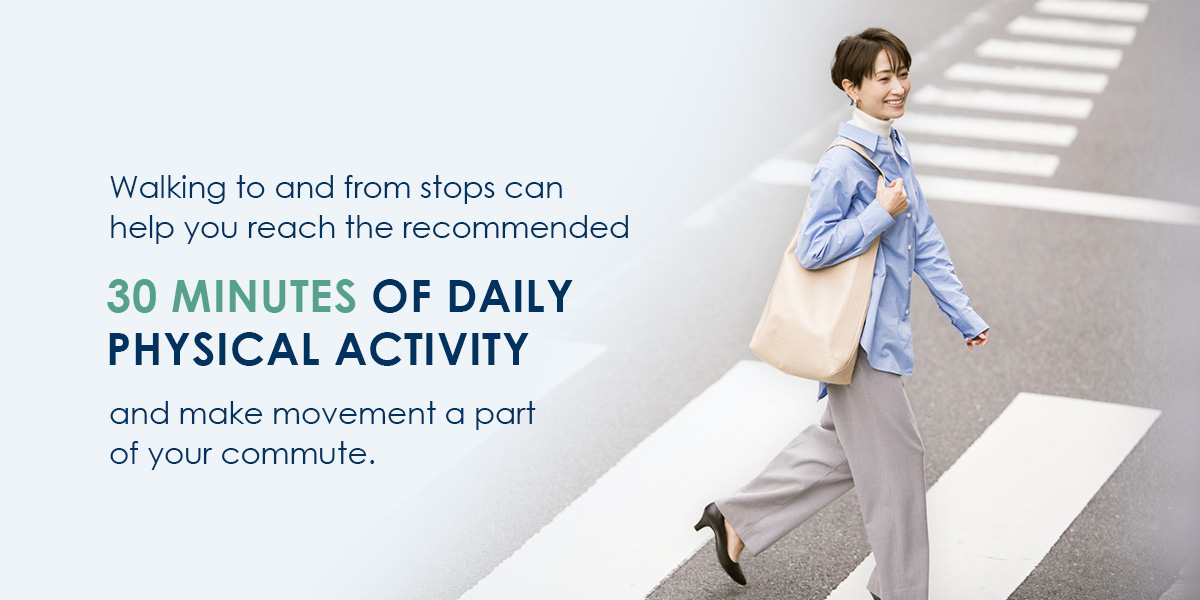
woman walking in a crosswalk

If you have access to nearby stops and your routine matches route timetables, public transportation can provide a steady and manageable way to get to work. Start by locating the nearest service and reviewing route schedules.

Biking

Biking is an active commuting option that offers an efficient way to work exercise into your day. It can help improve heart health and reduce the risk of chronic conditions. Biking also gives your brain a break by allowing you to disconnect from daily stressors and engage with your surroundings. So, you arrive at work feeling clearer, calmer and more focused.

Since you’re pedaling instead of paying at the pump, biking is one of the lowest-cost commuting options. Those without a bike can still consider this smart commuting option by looking for nearby bike-sharing programs or rental services.

If you are within about 2-6 miles, biking is just as fast as driving in traffic, and sometimes faster since you avoid parking hassles. To make the switch, think about the availability of bike lanes or low-traffic routes along your way. Consider whether your workplace has amenities, like bike racks and shower facilities, to freshen up before clocking in.

Walking

If you live close to your destination, walking is the simplest commute option. Like biking, walking as active transportation delivers physical and mental health benefits by building movement into your day without any extra effort.

Walking burns calories at a steady, sustainable rate and strengthens your muscles and joints. According to the American Council on Exercise (ACE), a 150-pound person walking at a moderate pace for 20 minutes burns 74 calories. Walking also boosts blood flow to your brain, which positively affects the areas that regulate stress.

Consider walking to work when you live within 1-2 miles of your workplace, and there is a route with safe sidewalks and crosswalks. Give yourself a buffer when planning your departure time so the commute feels relaxed rather than rushed. Listen to audiobooks, podcasts or music to make the time feel shorter and more enjoyable.

Telecommuting

Working remotely removes the commute entirely on the days you do it. Two or three remote days per week can meaningfully cut transportation costs and save stress and time. It also makes it easier to maintain healthy habits, like eating a proper meal in the morning and taking regular breaks, which can improve both your physical and mental well-being.

Consider telecommuting if your job allows it and you:

  • Have an area where you can focus without frequent interruptions.
  • Have reliable internet and the tools you need to work productively.
  • Are comfortable with digital communication.

Vanpooling

Vanpooling is where 5-15 riders share a single van and travel together along a regular route. It lowers commuting costs per person, which is particularly valuable when driving long distances. Vanpooling costs about $0.21 per passenger mile, according to the FY2024 National Transit Database.

Vanpooling is a strong fit for commuters with longer, more predictable routes, such as across counties. It works when a larger group can commit to a shared schedule. It’s also an accessible option if you are coming from areas with fewer direct connections.

To get started, follow these tips:

  • Set up a Commute PA account on our website or app.
  • Complete your profile so we can help match you with commuters who share similar routes and schedules.
  • Reach out to us to organize a meeting once you have found your matches. During this time, your group can finalize details like vehicle choice, route, schedule and shared expenses.
  • Check with your workplace about the availability of the $340 federal pre-tax benefit for vanpooling. We can also help speak to your employer about this.

Which Commute Option Is Best?

The best commute option is the one that fits your life. Here’s a recap table to help you think it through:

Commute option Best when you have Key benefits  What to consider
Carpooling  A consistent schedule and nearby co-workers or commuters
  • Share costs and driving responsibilities
  • Reduce vehicle wear and tear
  • Make the commute more social
Involves coordinating schedules and pickup points
Taking public transportation Access to nearby stops and routes that match your timetables
  • Eliminate the need to drive
  • Free up time for personal activities
  • Reduce congestion and emissions
Involves following routes and timetables
Biking  A short to moderate commute with safe or low-traffic routes
  • Reduce commuting costs
  • Build daily physical activity
  • Improve mental clarity
Involves access to bike-friendly routes and workplace amenities
Walking  A very short commute with safe sidewalks and crossings
  • Eliminate commuting costs
  • Incorporate steady physical activity
  • Support mental well-being
Involves safe routes and extra travel time
Telecommuting A role that allows remote work and a suitable home setup
  • Eliminate commuting costs and time
  • Support healthier daily habits
Involves setting up a space to work and establishing clear boundaries with others at home
Vanpooling A long-distance commute and a group of 5-15 riders with similar schedules
  • Lower cost per mile and per passenger
  • Expand access for areas with limited public transportation options
Involves organizing a larger group and sticking to a fixed schedule

Create a Personalized Commute Plan With Commute PA
create a personalized commute plan with CommutePA

We promote sustainable, smart commuting across Adams, Berks, Cumberland, Dauphin, Franklin, Lancaster, Lebanon, Perry and York counties. Sign up for free online or download our app to access resources for planning and recording your trips. We can help you:

  • Match rides for carpooling or vanpooling with people along similar routes.
  • Plan public transportation trips, including nearby stops, schedules and route options.
  • Find safe biking and walking routes and identify nearby facilities, like bike racks or trails.
  • Combine multiple modes of transportation.
  • Have peace of mind with reimbursement for your ride home from work in a qualified emergency.

You can also record your rides on our app and earn points to enter our monthly gift card drawings. Join our community and find carpooling partners with us today!
The Cost and Financial Perks of Ditching Your Solo Drive

The Cost and Financial Perks of Ditching Your Solo Drive 150 150 WebFX

Are rising fuel prices, constant wear and tear on your vehicle and endless parking fees draining your wallet? It is time to rethink your daily commute. Discover how smarter transportation choices can transform not just your journey, but also your financial well-being, freeing up significant savings you might not even realize are possible.

How Much Does Your Commute Cost You?

Beyond the daily grind, solo driving in Central PA carries a significant price tag. Let’s uncover the true expense:

  • Obvious costs of commuting: Gas, parking and tolls quickly add up. A solo commute means bearing 100% of these expenses, which can amount to a large portion of your annual budget. Fuel costs are particularly vulnerable to market fluctuations. Even modest price increases at the pump translate to hundreds of dollars in additional annual expenses for solo commuters.
  • Hidden expenses: Factor in frequent wear and tear on your vehicle, routine maintenance like oil changes and potentially higher insurance premiums. These unseen costs quietly drain your savings.
  • Time and health: Extended periods in traffic contribute to physical strain and mental stress. This lost time also means fewer opportunities for relaxation or for engaging in activities you enjoy.

The Perks of Smarter Commuting

Choosing smarter transportation options unlocks a host of benefits, both financial and personal:

  • Significant cost savings: Drastically cut your overall commuting expenses. Whether you carpool, vanpool, telecommute or use public transit, you’ll reduce exposure to fuel price volatility by sharing costs or eliminating them entirely.
  • Less car maintenance: Fewer miles driven means less wear and tear on your vehicle. Expect reduced maintenance needs and lower long-term car ownership costs.
  • Potential insurance premium reductions: Driving less leads to lower mileage on your vehicle, which might qualify you for discounts on your car insurance premiums.
  • Enhanced health and well-being: Options like walking or biking completely eliminate fuel costs while boosting your physical activity and mental clarity, contributing to a healthier, happier you.

Commute PA Makes Your Smart Commute Easy

Commute PA is a completely free program that makes embracing the benefits of smart commuting simple. If you commute in Adams, Berks, Cumberland, Dauphin, Franklin, Lancaster, Lebanon, Perry or York counties, you can use the Commute PA app or online platform to connect with fellow commuters traveling similar routes.

Download the Commute PA app or create your own profile online to start accessing personalized route planning and ride-matching. Plus, you can enter into our monthly gift card drawings when you log your trips in our app.

Are you ready to ditch your solo drives and cut unnecessary expenses? Travel smarter and easier with Commute PA today.

Commute PA Makes Your Smart Commute Easy

Last-Mile Commute Options

Last-Mile Commute Options 150 150 WebFX

Last-Mile Commute Options

As we all know, it’s not always about the destination — it’s sometimes all about the journey.

The “last mile” refers to the final distance in your journey, be it en route to work, school or an event, that is often not reachable by the same mode of transportation used for the main part of your journey. This obstacle poses numerous problems for commuters of all kinds, as well as for the environment.

Finding a solution to the last-mile conundrum involves finding a hassle-free, inexpensive transportation method that makes your journey more seamless from beginning to end. Keep reading to discover how smart trips can transform your commuting experience.

Last-Mile Commute Issues

Commuters face multiple challenges due to inadequate transportation methods, either at the start or end of their journey to a destination.

Longer Commutes

Despite the rise of hybrid or at-home working, the average commute length in America has been on the rise. In 2024, over 9% of commuters traveled over 60 minutes to get to work, and the average commute time reached 27.2 minutes. When there is no mode of transportation to take a commuter directly to their destination, journeys can take much longer than necessary.

Over time, long commutes can take a toll on mental health. Those who undergo long commutes may experience:

Heavier Reliance on Cars

When public transit can’t get you directly to your destination, it can be easy to turn to the seemingly hassle-free mode of transportation — driving. However, the more we rely on cars as a society, the more damage we do to our planet.

Long car commutes have devastating effects on the environment, including:

  • Air pollution: Vehicle emissions pollute our planet’s air with carbon dioxide, methane and other pollutants.
  • Water pollution: Runoff from roads carries toxic substances like oil and diesel to our water sources.
  • Destruction of habitats: The extraction of oil and gas, which is largely driven by consumer demand for fuel, is highly destructive to the natural habitats of animals and plants.

There are many things you can do to combat climate change on a personal level, and reducing your use of a personal car is one of them.

Physical Health Challenges

Alongside the mental toll that long or complex commutes can take on a person, sedentary commutes can also affect people’s physical health and activity.

When using one mode of transportation for your entire journey, such as a personal car, you might think you are eliminating the first- and last-mile commuting issue. But instead, you may be causing more problems for your well-being.

Sitting for more than four to six hours a day is generally considered sedentary. The more time you spend sitting during your commute, the more sedentary your lifestyle will be.

The implications of this can include:

Last-Mile Commuting Solutions

First- and last-mile commuting doesn’t have to be so arduous. We are lucky enough to exist in an era where technology is constantly advancing, and so are our transportation options.

If you want to improve your commuting experience and eliminate the last-mile complication, there are many last-mile commute options to consider.

Walking and biking are some of the best solutions to the last-mile dilemma

Walking and Cycling

Old-fashioned, active methods of transportation, such as walking and cycling, are some of the best solutions to the last-mile dilemma. Besides getting you to your destination without vehicle-related complications, like rush-hour traffic, these methods also offer numerous benefits for your health and the environment.

The health benefits of an active commute include:

  • Reduced mortality risk: Frequent 20-minute cycles or 30-minute walks can reduce mortality rate by 10% or more.
  • Lower BMI: Cycling to work has been linked to maintaining a lower body mass index (BMI).
  • Stronger immune system: Frequent walking has been associated with boosted immune systems.
  • Reduced breast cancer risk: Women who walk seven hours or more per week are 14% less likely to develop breast cancer than those who walk three or fewer hours.
  • Eased joint pain: Walking has been linked to both the prevention and reduction of joint-related ailments, like arthritis.

Public Transit

Traveling by bus or train offers commuters a budget-friendly, eco-conscious and relaxing way to commute. Regional transit offers multiple advantages over driving, including:

  • Productivity: Commuters can dedicate their time on public transit to anything they like, be it catching up on work, responding to emails or staying in touch with friends and family.
  • Relaxation: By removing the need to drive yourself to your destination, you can sit back, relax and enjoy the journey.
  • Affordability: Public transit is more affordable than owning and maintaining a private vehicle, and you don’t have to factor in extra costs like fuel and parking.
  • Sustainability: By switching out cars for public transit options, you can decrease your carbon footprint and contribute to reducing global emissions.
  • Social interactions: Public transportation allows commuters to connect with others and interact with people they might otherwise never meet.

Carpooling

Carpooling is a convenient and eco-friendly way to cut your commute costs and eliminate the last-mile problem. When you choose carpooling over driving alone, you can benefit from:

  • Lower commuting costs: Sharing a car journey with others enables you to split the costs of gas, tolls and parking with others.
  • Reduced emissions: With personal vehicles responsible for the majority of society’s greenhouse gas emissions, carpooling can significantly lower your carbon footprint.
  • Human connection: Sharing your commute with others gives you the chance to socialize and interact with fellow commuters.

Telecommuting

Since the COVID-19 pandemic, more employees across the globe have opted for remote working over traditional in-office work.

Telecommuting is the greenest mode of transportation. Whether you work fully remotely or on a hybrid basis, it has multiple benefits for your personal well-being and the environment:

  • Lower emissions: By eliminating commutes entirely, telecommuting contributes to lower greenhouse gas emissions and improved air quality.
  • Better work-life balance: By working from home, people have more flexibility in their schedule to prioritize what is important to them.
  • No commute costs: Without a commute, there are no commute costs! Working from home eliminates the need to figure out the last-mile dilemma, too.

Streamline Your Journeys With Our PA Commuting Programs

At Commute PA, we are dedicated to enhancing your commuter experience. By joining our commuting programs, you can transition away from costly single-occupancy vehicles to access resources to help with the last mile of your commute.

Whether you are a business looking to streamline your employees’ commutes or an individual in need of a better mode of transportation, Commute PA can guide you in finding the right route. From our ride-matching programs to our practical resources, we can help you find smarter ways to get from A to B.

Join our program for free or contact our team to find out more today!

Streamline your journeys with Commute PA


Winter Commuting Tips for Safer Travel

Winter Commuting Tips for Safer Travel 150 150 WebFX

While the temperatures and road conditions during the winter can pose challenges for commuting, there are ways to make your ride safer and easier. Discover winter commuting tips from Commute PA to help you create a smart winter weather commute plan.

Smarter Commutes for Winter

At Commute PA, we promote smarter options for commuting regularly. This includes a wide range of transportation options, including biking, walking, carpoolingvanpoolingtransit and even telecommuting.

In the winter, when road conditions get tougher and mobility becomes extra challenging, smart commuting provides alternatives. Benefits of exploring these options include:

  • Enhanced safety: Carpooling and vanpooling can be safer than driving alone. They reduce the number of cars on the road, leading to less congestion on icy roads.
  • Cost savings: Options such as carpooling and telecommuting can reduce fuel consumption during the winter months.
  • Health and well-being: Active transportation, like biking and walking, keeps you moving, while telecommuting lessens your exposure to weather-related illnesses, like cold and flu.

Top Commuting Tips for Biking in Winter Weather

Commuting in the winter is manageable if you know how and what to prepare. Refer to Commute PA’s winter bike commuting tips and driving suggestions.

1. Dress Appropriately

Wear multiple layers of clothing to stay warm and comfortable during your commute. If you’re concerned about your hands and feet, we recommend investing in some windproof gloves and waterproof boots! You can also increase your visibility with reflective clothing or flashing lights, especially if you have to travel in the dark when the days are shorter.

2. Plan Your Routes Ahead of Time

Check weather reports for snow-prone areas and potential route hazards. Exploring well-lit areas and prioritizing alternative routes with lighter traffic can also help you commute more safely in the winter.

3. Winterize Your Gear

If you’re planning on biking, equip your bicycle with front and rear lighting. Clean your bike to remove snow and dirt, then wax the frame and lubricate moving parts. Ensure your tires have the right pressure, both for bikes and vehicles. It’s important to keep the fuel tank at least half-full and antifreeze at the correct levels.

4. Take Public Transportation or Smarter Commute Options

Consider taking public transportation halfway to your destination. Many buses and trains have bike racks or storage spaces, or park your bike in a designated rack. Instead of biking, you can also opt to join carpooling and vanpooling groups along your route to lessen your exposure to the cold and avoid dangerous segments of your commute.

Consult Commute PA for Safe Winter Commuting

We promote initiatives geared toward reducing single-occupancy vehicle travel, including smart and active transportation. Contact us to learn more about our Emergency Ride Home program or join our rewards programs to incentivize your daily commute.

Consult Commute PA for safe winter commuting

Skip to content